Home › Commercial Asphalt Resurfacing & Overlays
Extend the life of your pavement with commercial asphalt resurfacing in Colorado Springs, CO. We mill or level existing surfaces, repair problem spots, and install a new asphalt overlay that restores appearance and performance with less cost and downtime than full reconstruction.
Precision Asphalt Colorado Springs provides professional commercial asphalt resurfacing throughout Colorado Springs, CO, Colorado and the surrounding area. Our licensed, insured crew delivers safe, clean, on-time work with a free estimate before anything begins. Call (719) 722-2508 or request your free quote.
Commercial Asphalt Resurfacing & Overlays For Colorado Springs Properties
Commercial asphalt resurfacing and overlay work is about extending the life of your pavement without paying for a full tear out and replacement. At Precision Asphalt Colorado Springs, we focus on commercial lots and drives in the Colorado Springs area, so our approach is based on what actually holds up in our freeze thaw climate, high altitude UV exposure, and mix of newer and older commercial buildings.
Most commercial resurfacing projects we handle involve existing asphalt that is structurally sound underneath but worn, cracked, or rough on top. Typical properties include retail shopping centers along Academy and Powers, office parks and medical facilities near downtown and along I 25, multi building HOAs and apartment complexes, light industrial yards, and church or school parking lots. We evaluate whether your pavement is a good candidate for an overlay or if certain areas need localized reconstruction before resurfacing.
Our goal is to give you a clear yes or no on resurfacing, explain why, and design the overlay thickness and materials around your actual traffic patterns, not a one size fits all template. That is how we get overlays that last in Colorado Springs conditions instead of failing after a couple of winters.
How Commercial Asphalt Resurfacing Is Actually Done
A commercial asphalt resurfacing project with Precision Asphalt Colorado Springs follows a specific sequence so the overlay bonds properly and drains correctly.
First, we perform a detailed condition survey. We walk the entire lot, mark structural failures, rutting, drainage issues, and any areas where the base has clearly failed. We also look at previous repairs and patchwork, because those can move differently under load than original asphalt.
Second, we mill or grind the surface as needed. For most overlays in Colorado Springs, we recommend milling at least 1 to 2 inches to remove oxidized material, smooth out birdbaths, and create a strong keyed surface for the new lift. On properties that need to maintain curb reveal or door thresholds, we mill transitions at tie in points such as entrances, dumpster pads, and ADA ramps so finished grades line up correctly.
Third, we repair failed areas before resurfacing. This can include full depth removal in pothole clusters or alligator cracked sections, then rebuilding with new base material and asphalt to match surrounding elevations. We do not simply overlay across bad spots since that traps movement underneath and leads to reflective cracking.
Fourth, we apply tack coat so the new asphalt bonds to the old surface. We use an emulsion tack that is sprayed uniformly, with attention to edges and joints where failure usually starts. Only after the tack has broken (turned from brown to black) do we place the overlay.
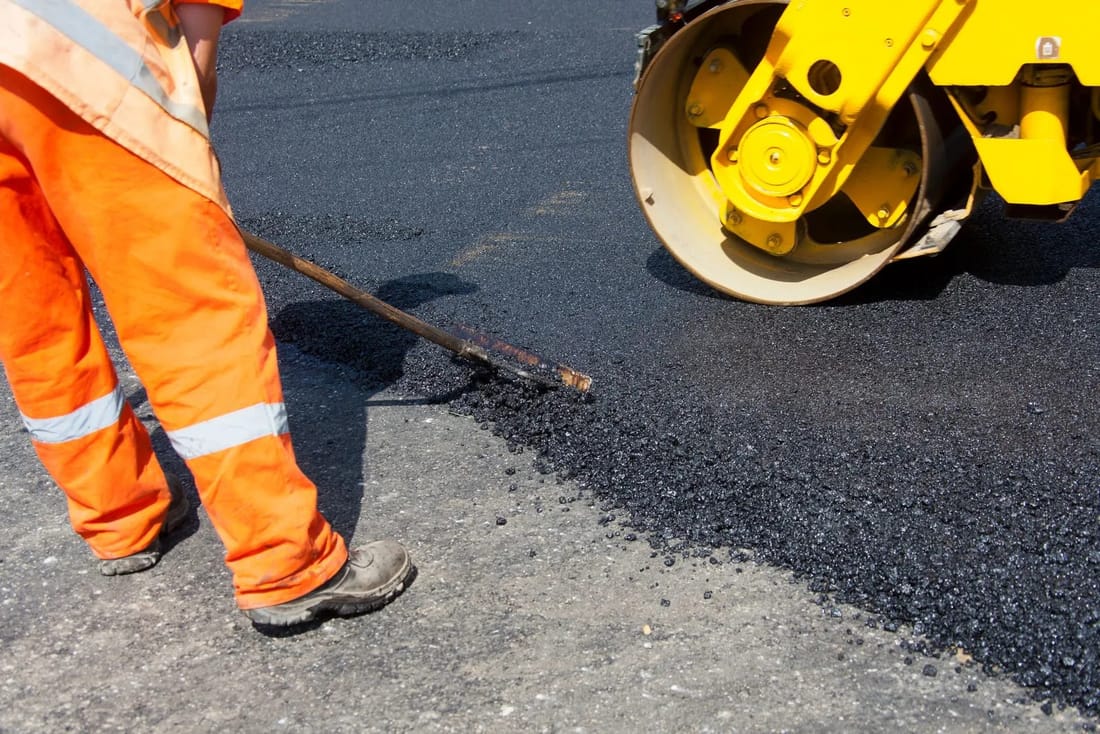
Fifth, we place and compact the new asphalt overlay. For light duty commercial parking lots we commonly install 1.5 to 2 inches of overlay. For heavier traffic lanes, fire lanes, or delivery routes, we increase thickness and sometimes use a different mix design for the wheel paths. Compaction is done with steel drum and pneumatic rollers, and we focus on density at joints and along drain inlets where raveling often begins.
Finally, we restore markings and signs. Once the asphalt has cooled, we re stripe stalls, ADA spaces, fire lanes, directional arrows, and crosswalks, and we reinstall or reset wheel stops if needed.
Asphalt Overlay Options, Mix Designs, And Thickness Choices
Commercial asphalt resurfacing is not just about putting down a random new layer. The overlay design needs to match your use. Precision Asphalt Colorado Springs looks at traffic volume, vehicle types, turning movements, and how snow is plowed on your property, then selects the right combination of overlay thickness and mix.
For retail and office parking lots with mostly car traffic, a 1.5 to 2 inch overlay using a dense graded hot mix is usually appropriate. These mixes are designed to resist raveling under turning movements from cars in tight parking aisles. For industrial sites, alleys that carry garbage trucks, and loading zones with frequent turning from semi trucks, we lean toward a thicker overlay and may recommend a stiffer mix or a separate heavy duty band down the drive lanes only.
We also look closely at Colorado Springs drainage patterns. Many older commercial sites have minimal or poorly located storm inlets, and overlays must be designed to preserve or improve positive drainage. That can mean minor grading changes in the asphalt overlay, additional milling near inlets, or creating subtle swales to move water away from building entrances and toward low points.
If your lot has recurring reflective cracking or previous overlays that failed early, we may discuss interlayer options such as paving fabric or a leveling course to help reduce crack reflection. These are not necessary on every job, but in certain Colorado Springs lots with long history of cracking from underlying expansive soils, these additions can be cost effective. We walk you through the pros and cons so you are not paying for treatments you do not need.
What Drives The Cost Of Commercial Asphalt Resurfacing
Pricing for commercial asphalt resurfacing in Colorado Springs is influenced by more than just square footage. Precision Asphalt Colorado Springs breaks costs down so property managers and owners understand where the budget is going.
The largest cost driver is the amount of milling and base repair required. A simple overlay with light surface milling and very few full depth patches will fall at the lower end of the cost range. Lots with widespread base failures, thick milling to correct grades, or extensive hand work around utilities and tight islands will cost more per square foot.
Overlay thickness and mix type also matter. A 1.5 inch overlay uses noticeably less material than a 2.5 inch overlay across a large shopping center. Heavy duty truck areas often use a higher performance mix, which is more expensive per ton but needed for long life.
Access and staging in Colorado Springs commercial settings can affect pricing as well. Sites that can be closed in large sections let us pave efficiently. Properties that must stay partially open, such as medical offices or grocery anchored centers, require more phasing, traffic control, and off hours work. That adds labor and sometimes night or weekend premiums.
Finally, layout details like phasing, striping complexity, and ADA improvements can change cost. If we are just re striping a straightforward parking field with standard stalls, that is simple. If the project includes reconfiguring layouts to meet current ADA standards, adding crosswalks, or coordinating with concrete crews for new ramps and curbs, that adds design and labor. We provide itemized proposals so you can see these elements separately.
Common Problems We Solve On Colorado Springs Overlay Projects
Colorado Springs commercial pavements see repeated freeze thaw cycles, intense sun, and regular plowing. Precision Asphalt Colorado Springs tailors resurfacing work to those specific issues so your overlay performs as long as possible.
Freeze thaw cycles often create cracking and heaving around joints, in patched areas, and near catch basins. Before overlaying, we identify and repair these areas so movement is minimized under the new layer. We also move settlement cracks into new layout patterns where possible so they do not sit under wheel paths.
Drainage is another frequent problem. Older centers along busy corridors often have low spots where water ponds and turns to ice in winter. Rather than simply paving over them, we correct grades during milling and overlay placement. That may include deeper milling in ponds, feathering new asphalt out of those zones, and adjusting frames around inlets. Proper drainage is critical because standing water dramatically shortens overlay life.
Snow plow damage is also common. We take into account how your snow contractor pushes and stacks snow when laying out joints and edge details. Straight, well compacted joints are less likely to catch plow blades. If your lot has a history of plow gouging, we can talk with your snow contractor about blade shoes and stacking locations so your new surface is protected.
Reflective cracking from underlying expansive soils is another regional concern. In known problem areas, we may recommend thicker overlays, select mix designs with better flexibility, or use reinforcing interlayers in high risk zones such as long drive entrances or heavy truck routes.
What To Know Before Hiring A Commercial Asphalt Resurfacing Contractor
If you manage a commercial property in Colorado Springs, there are specific questions you should ask before hiring anyone to perform commercial asphalt resurfacing.
First, ask how the contractor will determine if your lot is a candidate for an overlay instead of a full reconstruction. Precision Asphalt Colorado Springs will show you specific areas where the base is sound versus failed, explain how we test stability, and outline which sections need patching before resurfacing.
Second, request a written plan for milling depths, overlay thickness, and drainage corrections. You should see where transitions occur, how curb reveal will be maintained, and how they will avoid creating new low spots. A generic note that says “mill as needed” without clear limits is a red flag.
Third, confirm traffic control and phasing for your site. Colorado Springs shopping centers, offices, and medical buildings cannot always close fully. A solid contractor will phase work so customers and tenants can still access the property, coordinate with deliveries and trash pickup, and minimize downtime. We provide phasing diagrams when needed so you can communicate with tenants and users.
Finally, look at the contractor’s local experience with overlays, not just new paving. Ask for completed overlay projects in the Colorado Springs area that are several years old and still performing well. We are happy to point you to lots and driveways we resurfaced that you can visit and see how the overlay has handled traffic, weather, and plowing over multiple seasons.
A well planned commercial asphalt resurfacing project should extend the life of your pavement for many years, improve curb appeal, and reduce emergency repairs. With the right evaluation, design, and installation, an overlay can be a cost effective tool in your long term capital plan.